 Image: Curbed
Those plans include the permanent conversion of that 150-foot length of Mason Street into public open space in order to connect the new library to the playground next door.
 Image: Curbed
[Mayor Joe] Riley said he doesn't feel any sense of delay driving down Beaufain or Wentworth streets these days —streets the city changed to two-way traffic a few years ago. "Actually, it (going a little slower) is more pleasant because you don't have to worry about someone passing you and them mentally thinking they are on some big arterial highway," he said. -The Post and CourierThe city of Charleston is expanding on that success by moving forward to convert two busier streets to two-way traffic this fall.
During the past 15 years, City Hall has favored those who live and work on a street over those who simply drive along it. -The Post and CourierThe SFMTA should take note. The Northeast corner of San Francisco lives and work under the burden of one-way streets that are the most dangerous in the city. In my opinion there isn't a single one that couldn't benefit from a yellow stripe down the middle.
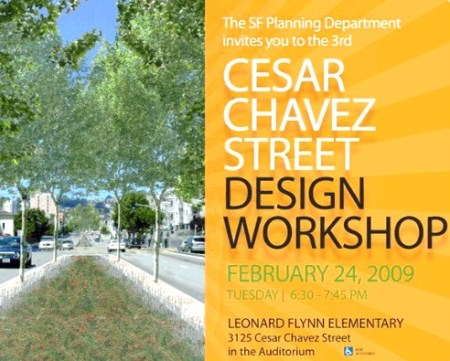 The Planning Department's City Design Group will hold its third and final workshop on a redesign plan for Cesar Chavez street between Guerrero and Hampshire:
First, we looked at how many lane miles of roads have been added to metropolitan areas since 2000 relative to the increase in traffic flow. ...I wouldn't peg this as a particularly rigorous measurement, but it's nice they recognized Transit as an important component of regional transportation.
Second, we assessed improvements to public transportation systems using ridership data from the U.S. Census and American Community Survey. The more people who use public transit, the better that system meets individuals' commuting needs.
But in the 21st century, economic and environmental problems are bringing new scrutiny to the idea that limiting spaces for cars may move more people more efficiently.As documented in Seoul, Boston and Montgomery, Alabama, the idea is that [gasp] wide arterial roads induce demand, which causes gridlock. Removing those expressways causes traffic to move more smoothly than it did before.
In the Boston example, Gastner’s team found that six possible road closures, including parts of Charles and Main streets, would reduce the delay under the selfish-driving scenario.The article also documents positive results from conversion of divided rights of way to the "shared street" concept, or woonerf. In a woonerf, all modes of transportation are allowed on any part of the road, and traffic signals and lane markers are absent.
The idea is that the absence of traffic regulation forces drivers to take more responsibility for their actions. “The more uncomfortable the driver feels, the more he is forced to make eye contact on the street with pedestrians, other drivers and to intuitively go slower,” explains Chris Conway, a city engineer with Montgomery, Ala.And finally, author Linda Baker gives props to SF for our parking maximums:
In San Francisco, for example, developers must restrict parking to a maximum of 7 percent of a building’s square footage, a negligible amount. Although downtown employment has increased, traffic congestion is actually declining, [Patrick] Seigard says. With fewer free spaces to park, drivers seem to be switching modes, relying more on mass transit, cycling and just plain walking.Imagine that.
Think of Soviet shoppers spending their lives in endless queues to purchase artificially low-priced but exceedingly scarce goods. Then think of Americans who can fulfill nearly any consumerist fantasy quickly but at a monetary cost. Free but congested roads have left us shivering on the streets of Moscow.
Editor - As a former San Franciscan who now lives in the North Bay, my response to the proposed "congestion pricing" schemes is: "Are you kidding?"For a city that fiscally depends on outsiders - tourists, commuters, shoppers and diners - congestion pricing is a really stupid idea. There is no good public transportation to get to San Francisco from the North Bay unless you are commuting to the downtown business district. Outside commute hours, the ferries and buses run infrequently, and after a late dinner, there is no way to get back to Marin. Even finding a taxi is practically impossible.
In addition, those proposing this idea might look at a map. Most of the time I'm driving through the "ring" I'm not driving to San Francisco, I'm driving through it to get to the airport or somewhere else on the Peninsula. Want to relieve congestion? Build a freeway from the Golden Gate Bridge to the intersection of 101 and 280 just south of Parkmerced, and you won't have to worry about us again.
SARAH CAMERON LERER
Inverness
Letters to the Editor, SF Chronicle, January 1, 2009
No, Ms. Lerer, we're not kidding. San Francisco, specifically the older, denser northeaster corner of the city, has been suffering under the burden of motor vehicle congestion for decades!
It's difficult to know where to begin tearing this letter apart, but her specific arguments don't even weigh against the specific plan for downtown San Francisco. She is worried that the only public transit options from the North Bay take you to the downtown, and are only reliable during commute hours. Fortunately, this is the only part of town, and the only time of day that will be affected by the congestion fee.
She also laments that the fee is unfair because she's only passing through the congestion zone, not visiting it. She even suggests that we build a freeway through our city to get her to I-280. This is exactly the kind of trip that worsens congestion without providing any benefits to the local economy, and it's exactly what congestion pricing is designed to prevent or move to off-peak hours.
If you want to push one of my hot buttons, try suggesting that the elevated freeways that scar our city are a good thing, or that we need more of them. Building a freeway the entire length of San Francisco won't mean we never have to worry about those cars or the people in them ever again, it will mean blight, crime, higher rates of asthma, heart disease and a slew of the other unarguable effects of high vehicle traffic volumes. What's more, California Highway 1 already runs the entire route she wants, via Park Presidio Blvd and 19th Ave. The status quo along that gem of a roadway is unacceptable exactly because it's overused by Ms. Lerer and her ilk.
The city of San Francisco doesn't owe suburban residents a free ride through our neighborhoods. Congestion pricing is not punitive, it offsets real costs that the city has been shouldering all these years. The plan is sound and serves to allow drivers, cyclists, and those who walk and take the bus to make more well-informed economic decisions about their transportation options.


 Posts
All Comments


