
More transit means more pedestrians, more people who pay attention to the shape and design of the city up close. That, in turn, means a growing constituency for shared space in Los Angeles and new interest in our long-neglected streetscapes and public sphere.
To put it another way: Transit and the life of the street are inextricably intertwined, and a boost to one is almost always a boost to the other. -
Showing posts with label transit. Show all posts
Showing posts with label transit. Show all posts
Wednesday, November 18, 2009
Quote of the Day

Wednesday, July 22, 2009
Development Oriented Transit
I read Streetsblog New York's piece on BRT yesterday, and thought about mentioning some arguments in opposition to BRT, but held off.
Good decision, it turns out, since The Overhead Wire can be counted on to make the case against BRT far more passionately than I can. That post and the comments it generated are definitely worth a read, but one remark in particular struck me:
Good decision, it turns out, since The Overhead Wire can be counted on to make the case against BRT far more passionately than I can. That post and the comments it generated are definitely worth a read, but one remark in particular struck me:
Thursday, July 16, 2009
SF's Own Second Ave Subway
Not down Second Avenue in the Richmond District, naturally. The title refers to the eighty-year-long history of the as yet unbuilt Subway line under Second Avenue in Manhattan.

This map was drawn in 1931, two years after the Second Avenue line in New York was proposed. I have a copy of this hanging in my hallway, so I was surprised when I noticed the other day that it includes a couple lines that transit enthusiasts would still love to see built.

This map was drawn in 1931, two years after the Second Avenue line in New York was proposed. I have a copy of this hanging in my hallway, so I was surprised when I noticed the other day that it includes a couple lines that transit enthusiasts would still love to see built.
Sunday, May 10, 2009
Sunday Streets Recap
I spent Mothers Day with my own mother on Third Street in this year's Bayview Sunday Streets. There may have been fewer people at this event than last month's Embarcadero closure, but not by much. The route was longer and the weather was perfect.
The businesses along Third Street set a very different tone for this month's event than the last. Many merchants offered special promotions or publicity programs, adding a level of engagement that was not so present on the Northern waterfront.
It was also a great excuse to see the construction progress in Mission Bay. The streets still haven't reached a level of connectivity that makes it easy to explore, and the oversize scale of the buildings makes it somewhat overwhelming. But mandates for public art in and around the straight-outta-Santa Clara commercial buildings provide some fun discoveries.
The segment along Dogpatch is layered in history. The old shipyard awaits restoration and redevelopment across from brand new apartments, which are already occupied.
I still don't understand why the route turned off of Third Street ad Islais Creek. The two events last year used this same route, and there were clear problems with the abandoned tracks along Illinois Street. Third is not especially heavily traveled between Islais and Mission creeks, and Illinois is a very wide road. Cars could easily be diverted onto Illinois if the capacity of Third was a concern.
There will be four more Sunday Streets events this year - one per month until September.
The businesses along Third Street set a very different tone for this month's event than the last. Many merchants offered special promotions or publicity programs, adding a level of engagement that was not so present on the Northern waterfront.
It was also a great excuse to see the construction progress in Mission Bay. The streets still haven't reached a level of connectivity that makes it easy to explore, and the oversize scale of the buildings makes it somewhat overwhelming. But mandates for public art in and around the straight-outta-Santa Clara commercial buildings provide some fun discoveries.
The segment along Dogpatch is layered in history. The old shipyard awaits restoration and redevelopment across from brand new apartments, which are already occupied.
I still don't understand why the route turned off of Third Street ad Islais Creek. The two events last year used this same route, and there were clear problems with the abandoned tracks along Illinois Street. Third is not especially heavily traveled between Islais and Mission creeks, and Illinois is a very wide road. Cars could easily be diverted onto Illinois if the capacity of Third was a concern.
There will be four more Sunday Streets events this year - one per month until September.
Monday, May 4, 2009
Fingers Crossed, BOS Just Might Reject MTA Budget
Sources in-the-know say it looks likely that the SF Board of Supervisors will find enough votes to reject the SFMTA's budget, which is badly flawed. This as Beyond Chron reiterates its opposition to the current budget and new-and-already-awesome blog SwitchingModes.com adds its voice to team 'No.'
They should do just that and I'd like to encourage you to contact your supe of you haven't yet done so.
There are so many good reasons to reject this budget that have been put forth by so many sharp minds in the transit advocacy and progressive community:
They should do just that and I'd like to encourage you to contact your supe of you haven't yet done so.
There are so many good reasons to reject this budget that have been put forth by so many sharp minds in the transit advocacy and progressive community:
- Raising fares and cutting service hurts ridership
- This budget balances the deficit on the backs of Muni's poorest users
- In creating this budget, the SFMTA board has shown an inclination to avoid making drivers pay their fair share of road costs
- This budget represents a sharp departure from the goals and promises of the much-touted TEP
Wednesday, April 29, 2009
Free Transit in Sydney?
Could be on the horizon in Australia's largest city. It seems to be part of a bid to win elections (note to SF, CA, and US pols), and it seems to be an attempt to appeal to suburban voters who are sick of paying more for the system. But what really stood out was this gem:
Every major Australian city already has a free CBD tram or bus service. -news.com.auIf I could pass another note on to our civic leaders: everybody's doing it!
Tuesday, April 21, 2009
Yes We Can
Immediately after clicking 'publish' on that last post I received a Facebook message from a friend, linking me to this inspiring charticle from Good magazine. Unsurprisingly absent is any Bay Area project, but we can still hope.
A Rail Is Not a Rail Is Not a Rail
In Utah they're planning a streetcar network to feed their light rail system.
SFMTA planners might be forgiven for being confused about the difference between the two systems. Here in San Francisco the mention of "light rail" evokes the N-Judah or the T-Third. We think we have light rail and we think that "light rail" means a rail car that has to straddle the competing restrictions of an underground tunnel and on-street operation.
In my opinion, Utah is doing it right. Build a robust rapid rail system (Utah's TRAX) and then a completely separate feeder system. Tailor each system to fit the role it fills.
San Francisco has done it wrong, we've built a system that switches from unreliable rapid rail downtown to overbuilt local feeder service at its extremities. Because the same equipment must fill two completely different roles, it's encumbered by 'features' that may be advantageous in one mode but reduce efficiency in the other.
Muni recognized the problems of transitioning its LRVs from high-platform underground stations to surface-level boarding and operation in mixed traffic. Their solution was to build every station on the T-Third line with high platforms at a massive expense and to separate train platforms from passengers on the sidewalk by lanes of auto traffic. Neither of these solutions do much to improve the system, and the T-third has had a tepid reception at best.
Given my druthers, San Francisco would have a rapid rail network that was built to be just that, and would serve the parts of town with a demand for a rapid network. Augmenting this network would be another network or feeder lines. Those lines, like the ones proposed for the Beehive State, would be
But a bus is not a streetcar. The 38-Geary and 14-Mission are frustrated by private auto traffic and long dwell times at stops. Buses can only be so long, so if you need to carry more passengers you need more buses - and more drivers. The diesel and electric trolley buses that run down these lines endure a beating from uneven streets and must be replaced much more frequently that a typical streetcar. The bumpy, jerky, slow and unpredictable service these workhorses provide is a turn-off for a large chunk of people who would otherwise ride them.
Running buses on these routes costs Muni in maintenance and operating costs in addition to the opportunity cost of potential riders (many of whom drive instead, competing for space and compounding the problem).
Don't get me wrong, buses fit an important niche in a transit network. Buses can reach into low-density neighborhoods and run less-frequent local service cheaper than a streetcar, especially in hillier parts of San Francisco. But where buses are run like streetcars, they fail to perform as well.
Furthermore, the lack of differentiation between a rapid network, feeder network and local network leads good people to make generalizations about transit service that I fear hurt its image, reduce expectations and ratchet down service in the end. Gripes about slow bus lines could be more easily rebutted if we all understood that bus lines were slower, more infrequent, and more local whereas grade-separated rail lines are fast, frequent, but require a longer walk or connecting ride.
It's a sad state of affairs when Muni can't get funds to expand service or make capital improvements because the average San Franciscan doesn't trust Muni with the money. That's a death spiral. Poor service begets lower budgets beget service cuts. Do not pass Go, do not collect $200.
We need leaders to imagine and realize a future for Muni, like they have in Utah. And if our leaders won't do it then we need to do it ourselves.
SFMTA planners might be forgiven for being confused about the difference between the two systems. Here in San Francisco the mention of "light rail" evokes the N-Judah or the T-Third. We think we have light rail and we think that "light rail" means a rail car that has to straddle the competing restrictions of an underground tunnel and on-street operation.
In my opinion, Utah is doing it right. Build a robust rapid rail system (Utah's TRAX) and then a completely separate feeder system. Tailor each system to fit the role it fills.
San Francisco has done it wrong, we've built a system that switches from unreliable rapid rail downtown to overbuilt local feeder service at its extremities. Because the same equipment must fill two completely different roles, it's encumbered by 'features' that may be advantageous in one mode but reduce efficiency in the other.
Muni recognized the problems of transitioning its LRVs from high-platform underground stations to surface-level boarding and operation in mixed traffic. Their solution was to build every station on the T-Third line with high platforms at a massive expense and to separate train platforms from passengers on the sidewalk by lanes of auto traffic. Neither of these solutions do much to improve the system, and the T-third has had a tepid reception at best.
Given my druthers, San Francisco would have a rapid rail network that was built to be just that, and would serve the parts of town with a demand for a rapid network. Augmenting this network would be another network or feeder lines. Those lines, like the ones proposed for the Beehive State, would be
An electric rail car that can run through a lane of traffic. In many ways it's similar to TRAX, [UTA's assistant general manager Mike] Allegra said, but it's lighter, so laying the tracks doesn't require such fortification. The result is a lower price tag, partly because underground utilities aren't affected.A car on this network would be
Low to the ground and requires no station platform -Salt Lake TribuneIf you're following along I expect you'd be wondering if I've ever noticed Muni's bus network. Our (arguably unmatched) bus network serves this role for most of the denser parts of the city. Along the Market Street tunnel and BART line, Muni's busiest bus lines filter residents from their homes to the rapid rail stations and back every day, many all day.
But a bus is not a streetcar. The 38-Geary and 14-Mission are frustrated by private auto traffic and long dwell times at stops. Buses can only be so long, so if you need to carry more passengers you need more buses - and more drivers. The diesel and electric trolley buses that run down these lines endure a beating from uneven streets and must be replaced much more frequently that a typical streetcar. The bumpy, jerky, slow and unpredictable service these workhorses provide is a turn-off for a large chunk of people who would otherwise ride them.
Running buses on these routes costs Muni in maintenance and operating costs in addition to the opportunity cost of potential riders (many of whom drive instead, competing for space and compounding the problem).
Don't get me wrong, buses fit an important niche in a transit network. Buses can reach into low-density neighborhoods and run less-frequent local service cheaper than a streetcar, especially in hillier parts of San Francisco. But where buses are run like streetcars, they fail to perform as well.
Furthermore, the lack of differentiation between a rapid network, feeder network and local network leads good people to make generalizations about transit service that I fear hurt its image, reduce expectations and ratchet down service in the end. Gripes about slow bus lines could be more easily rebutted if we all understood that bus lines were slower, more infrequent, and more local whereas grade-separated rail lines are fast, frequent, but require a longer walk or connecting ride.
It's a sad state of affairs when Muni can't get funds to expand service or make capital improvements because the average San Franciscan doesn't trust Muni with the money. That's a death spiral. Poor service begets lower budgets beget service cuts. Do not pass Go, do not collect $200.
We need leaders to imagine and realize a future for Muni, like they have in Utah. And if our leaders won't do it then we need to do it ourselves.
Wednesday, April 8, 2009
Speak Out Against Muni Service Cuts and Fare Hikes
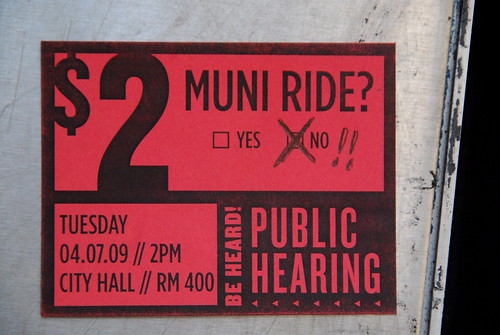
Transbay Blog and SBSF have good writeups of yesterday's SFMTA Board of Directors Meeting at City Hall. The next meetings where you will have a chance to weigh in on the proposed changes to Muni's budget are Tuesdays the 14th at 9am and 21st at 2pm. These meetings have been added to the list of Important Dates in the sidebar.
For those of you, like me, who cannot attend a multi-hour-long meeting in the middle of the week, please use any means necessary to contact the SFMTA and leave your comments.
Tell your friends, post fliers, organize groups to attend the meetings. This is a big freaking deal, people. The basic Muni service we all rely on is in very real danger of being cut to the point where it becomes useless. The number of Muni trips in a day roughly equals the population of San Francisco - and there's no place else for us to go!
Monday, April 6, 2009
Transit Race Followup
SBLA has a great followup to the transit race they told us about a couple months ago.
I have to reiterate what a great experiment I think this is. The organizers and participants apparently all learned something new about LA's transit network. Mr. Newton at SBLA is already forwarding suggestions for the next race, which I hope is in the offing.
I'll hold off on my inate Norcal/Socal rivalry to advocate that this be an idea we appropriate from our quaint southern neighbors. Who's coming with me?
I have to reiterate what a great experiment I think this is. The organizers and participants apparently all learned something new about LA's transit network. Mr. Newton at SBLA is already forwarding suggestions for the next race, which I hope is in the offing.
I'll hold off on my inate Norcal/Socal rivalry to advocate that this be an idea we appropriate from our quaint southern neighbors. Who's coming with me?
Wednesday, February 25, 2009
Is There Such Thing as a Free Way?
Posted nearly side-by-side today on Planetizen's news feed are two articles which should be read as parts of the same story.
Why Is Fare-Free Transit The Exception Rather Than The Rule? explores the thoughts that go into transit planners' decisions to charge fares for their service. Congressman Revives Effort to Ban Freeway Tolls discusses the efforts of Pennsylvania Republican Glenn Thompson to make sure nobody is ever charged to use the Interstate freeways.
Freeways and public transit systems are both pieces of transportation infrastructure, which we depend on for our economic vitality
No transit agency can run on fare revenue alone, and fare increases are a bad option for financially pinched transit operator. What fares and tolls do well, however, is suppress the demand for the transit service. Normally that's not something you'd want to encourage, but it can be a useful tool.
Congestion pricing on roads, higher bridge tolls at peak commute hours, and even variable fares for transit during peak commute hours can make a transportation network run more efficiently. Progressive funding strategies for New York's transit network include higher subway costs during commute hours to keep the system's capacity from being overwhelmed, but off-peak rates would go down to zero.
Here in SF, a study of the cost per revenue of Muni's fare collection pretty much killed any hopes of our largest transit agency going fare-free. Unlike most agencies, Muni collects significantly more in farebox revenue ($112 Million) than it spends on collection ($8.4 Million). Personally I wonder whether the latter number includes fare enforcement, but I doubt those inspectors cost $100 million per year.
But most of the argument provoked by that study revolved around the increased costs to Muni for the extra service it would have to provide. Which raises the question, shouldn't providing more service be a priority for Muni? I understand Nat Ford and the folks at the MTA lack the luxury of making that decision themselves - they're hamstrung by the hurdles that we in California have to go through to raise new revenues in this state. But maybe we're all too resigned to the status quo.
It's time for policy makers to get behind a real initiative to increase transit ridership and service levels. Yes, that will mean raising money. And yes, some of that should come from those who use the system at its peak load times. But we need to stop pitting the goal of raising revenue against the goal of increased ridership.
Why Is Fare-Free Transit The Exception Rather Than The Rule? explores the thoughts that go into transit planners' decisions to charge fares for their service. Congressman Revives Effort to Ban Freeway Tolls discusses the efforts of Pennsylvania Republican Glenn Thompson to make sure nobody is ever charged to use the Interstate freeways.
Freeways and public transit systems are both pieces of transportation infrastructure, which we depend on for our economic vitality
The Interstate Highway System -- the greatest public works project in history -- was built with federal funding to unite our nation. The Interstate Highway System's profound effect upon the American economy has contributed significantly to development and improved quality of life through increased economic efficiency and productivity. The Keeping Americas Freeways Free Act will preserve this notion and allow for the free flowing of commerce not only in Pennsylvania, but across the nation. -Glenn ThompsonAnd that statement is just as true if you replace "Interstate Highway" with "Municipal Railway." But we don't think that way, and Dave Olsen argues that it's to our detriment.
Now given that public transit is a public service, it could make sense to maximize the public good that that service brings, which is exactly what Island Transit and other Fare-Free systems have done. However, I'm writing "could" here because in the mad rush to privatize and maximize profit for anything that moves (including public services) this playing field has been fundamentally altered over the past few decades. -Dave OlsenTransit operators have been asked to meet two goals: to locate revenue sources and to increase ridership. But increasing fares pits one of these goals against the other, often at the expense of both. Raising fare rates drives down ridership, thereby offsetting any potential revenue increase. What's more, the costs of collecting fares often approach or exceed the revenue they bring in.
No transit agency can run on fare revenue alone, and fare increases are a bad option for financially pinched transit operator. What fares and tolls do well, however, is suppress the demand for the transit service. Normally that's not something you'd want to encourage, but it can be a useful tool.
Congestion pricing on roads, higher bridge tolls at peak commute hours, and even variable fares for transit during peak commute hours can make a transportation network run more efficiently. Progressive funding strategies for New York's transit network include higher subway costs during commute hours to keep the system's capacity from being overwhelmed, but off-peak rates would go down to zero.
Here in SF, a study of the cost per revenue of Muni's fare collection pretty much killed any hopes of our largest transit agency going fare-free. Unlike most agencies, Muni collects significantly more in farebox revenue ($112 Million) than it spends on collection ($8.4 Million). Personally I wonder whether the latter number includes fare enforcement, but I doubt those inspectors cost $100 million per year.
But most of the argument provoked by that study revolved around the increased costs to Muni for the extra service it would have to provide. Which raises the question, shouldn't providing more service be a priority for Muni? I understand Nat Ford and the folks at the MTA lack the luxury of making that decision themselves - they're hamstrung by the hurdles that we in California have to go through to raise new revenues in this state. But maybe we're all too resigned to the status quo.
It's time for policy makers to get behind a real initiative to increase transit ridership and service levels. Yes, that will mean raising money. And yes, some of that should come from those who use the system at its peak load times. But we need to stop pitting the goal of raising revenue against the goal of increased ridership.
Friday, February 20, 2009
Transit Race!
What a wonderful idea! The Bay Area could certainly use an event like this.
Transit People, "an all-volunteer Los Angeles non-profit that conducts educational, one day trips for school groups using the public transit system," is organizing a race from a starting point to a secret location. The catch is that you need to rely on your encyclopedic knowledge of public transit to get there!
I freaking love this idea.
Transit People, "an all-volunteer Los Angeles non-profit that conducts educational, one day trips for school groups using the public transit system," is organizing a race from a starting point to a secret location. The catch is that you need to rely on your encyclopedic knowledge of public transit to get there!
I freaking love this idea.
On race day: at 10:00 a.m. sharp (okay, maybe a few minutes later), your team leader will receive a phone call announcing the race destination. Your team then must figure out the best transit route to get there.Imagine something like the MTC using an event like this to sign folks up for Translink, maybe with the prize being a Translink card pre-loaded with a couple hundred bucks.
Wednesday, February 4, 2009
America's Most Improved Commutes
I followed Streetsblog LA to this story: SF has the fourth most improved commute in America, behind Boston, Milwaukee and Cleveland.
According to Forbes Magazine,
The numbers for San Francisco:
According to Forbes Magazine,
First, we looked at how many lane miles of roads have been added to metropolitan areas since 2000 relative to the increase in traffic flow. ...I wouldn't peg this as a particularly rigorous measurement, but it's nice they recognized Transit as an important component of regional transportation.
Second, we assessed improvements to public transportation systems using ridership data from the U.S. Census and American Community Survey. The more people who use public transit, the better that system meets individuals' commuting needs.
The numbers for San Francisco:
- Improvement in road construction versus traffic since 2000: -0.7% (17th best)
- Commuters using public transit in 2000: 9.4% of metro residents
- Commuters using public transit in 2007: 13.6% (3rd best increase)
- Traffic delays, per commuter, per year, due to congestion: 60 hours
Subscribe to:
Posts (Atom)


 Posts
Posts


