
Showing posts with label BRT. Show all posts
Showing posts with label BRT. Show all posts
Monday, May 17, 2010
Rail-ready BRT
The Transport Politic follows up today on news of Ottawa, Canada's plan to convert it's bus-only Transitway to light rail. It's worth reading because the Geary BRT project here in SF is using exactly the same "rail-ready" model that Yonah Freemark attributes to Ottawa, a model that may not realize the kind of cost savings its proponents frequently cite.

Wednesday, July 22, 2009
Development Oriented Transit
I read Streetsblog New York's piece on BRT yesterday, and thought about mentioning some arguments in opposition to BRT, but held off.
Good decision, it turns out, since The Overhead Wire can be counted on to make the case against BRT far more passionately than I can. That post and the comments it generated are definitely worth a read, but one remark in particular struck me:
Good decision, it turns out, since The Overhead Wire can be counted on to make the case against BRT far more passionately than I can. That post and the comments it generated are definitely worth a read, but one remark in particular struck me:
Wednesday, July 8, 2009
How Do You Feel About Van Ness BRT?
The Van Ness Avenue Bus Rapid Transit (BRT) Citizens Advisory Committee has a vacancy - they need you to apply for the open spot on the committee!The next meeting of the VN CAC will be:
Tuesday, July 14
5-7 pm
100 Van Ness Avenue, 26th Floor (between Fell and Hayes)
Tuesday, July 14
5-7 pm
100 Van Ness Avenue, 26th Floor (between Fell and Hayes)
Tuesday, July 7, 2009
Free Event for the Great Streets Project
The San Francisco Great Streets Project is hosting a free public forum featuring Enrique Peñalosa, the former mayor of Bogotá, Colombia. Peñalosa is famous for de-prioritizing private car use in Bogotá. His most wide-reaching legacies are the ciclovía (emulated most recently in SF's Sunday Streets event) and BRT.
The event is called Sunday Streets to Great Streets. Details after the jumpDate: Tuesday, July 7, 2009
Time: 5:30pm - 7:30pm
Location: Koret Auditorium, Main Public Library
Street: 100 Larkin St.
City/Town: San Francisco, CA
Cost: Free
Valet bicycle parking provided.
The event is called Sunday Streets to Great Streets. Details after the jumpDate: Tuesday, July 7, 2009
Time: 5:30pm - 7:30pm
Location: Koret Auditorium, Main Public Library
Street: 100 Larkin St.
City/Town: San Francisco, CA
Cost: Free
Valet bicycle parking provided.
Monday, June 29, 2009
Toward a Robust Rapid Transit Network: The H-Potrero Van Ness
Don't expect me to get in the habit of quoting Chuck Nevius, but this excerpt from his June 6th column about 49ers stadium negotiations rang a bell in my mind:
Public transportation is one of the team's major concerns with a San Francisco site.Niners Chief Financial Officer Larry MacNeil said the Hunters Point proposal would require that 25 percent of patrons travel on public transit.
When asked what the percentage is now at Candlestick, MacNeil said 18 percent of fans arrive on buses.
Well, that doesn't sound so insurmountable. Add a few more buses. Maybe Sen. Dianne Feinstein, who wants the team to stay in San Francisco, would help find the cash for a light-rail line. -SF Chronicle
Big freaking 'maybe,' to say the least. But stadium or no, SF Lennar is building thousands of homes on HP come hell or high water (certainly the latter) and those people will need more transit options than currently exist in that corner of town.
Enter a blast from the past: Muni's old H line
Friday, May 29, 2009
Keep Hope alive
I take sick pleasure in reading posts like this. They keep alive a dream that will almost certainly be dashed by the intellectual giants at the SFCTA.
One point that The Overhead Wire touched on that I think is important is that a proper setup for this corridor involves grade separated rapid transit (subway) in addition to an improved surface line.
One point that The Overhead Wire touched on that I think is important is that a proper setup for this corridor involves grade separated rapid transit (subway) in addition to an improved surface line.
Monday, May 4, 2009
SFCTA Prefers Wrong Option for Geary
What a week for any agency called SF_TA!
The Examiner reports that the SFCTA (San Francisco County Transportation Authority, not to be confused with the MTA) has surprised nobody and chosen center-lane BRT as the preferred option for the Geary corridor. I'm inclined to agree with what The Overhead Wire says about this conclusion: that it's based on unrealistically high estimates of the cost of rail, and unrealistically high estimates of the ridership of BRT.
It evokes a point frustrated transit advocates repeat like a mantra - Why is building a road with extra room considered to be planning for the future, whereas building a transit route with extra capacity is considered a waste of money?
Transit is just as susceptible to the if-you-build-it-they-will-come of induced demand as roads are. If you build a robust, rapid rail line underneath Geary, you will get more riders than you think (as Phoenix did) and your investment will pay off as population and retail activity along the corridor increases.
Friday, February 27, 2009
Western Neighborhoods Plan
Vancouver's about to launch its "Laneway Housing" pilot project. The project aims to encourage owners of single-family homes in the middle of the city to build small in-law cottages on place of existing garages. Apparently garages in these parts of Vancouver front on back alleys, or lanes, hence the name.
The idea isn't without controversy, but the goal is to expand the diversity of housing stock in the city by building small, more affordable units. This would also densify the neighborhoods, meaning more people could live closer to work, grocery stores, etc.
A couple problems with the Canadian plan stuck out to me, including the ability for property owners to keep up to three parking spaces. That would allow the new residents to clog local streets with more cars, rather than increasing the walkability of the neighborhoods.
But the basic idea is good, and worth emulating in the almost-walkable, relatively high-density suburban areas of the Bay Area, including the City and County's own suburbs among the dunes on the West side of town.
 Take this random stretch of Judah St. I literally double-clicked at random on MapJack to find this scene. The N-Judah runs in front of these houses night and day, but they all have garages! A decision by the city to allow in-law units in place of those garages would double the density of units in this picture. And all without casting any new shadows or otherwise disrupting the architectural character of the neighborhood.
A zoning change or a streamlined process for building and approving these in-law units would provide financial benefit for those homeowners on this robust segment of rail infrastructure who don't drive much, or might be willing to give up a parking space for some extra rental income.
Our city leaders tell us every chance they get that we need to find a way to fit more housing into SF. Their solution for the last three decades has been to put that in the "Eastern Neighborhoods." These neighborhoods - SoMa, the Mission, Potrero Hill and also Bayview - are being made to bear this load because there are pockets of industrial land that are going out of use for various reasons, but also because it's politically possible to do so; residents of those neighborhoods don't have ebough of voice in city government to stop it.
For reasons worth exploring (but not now) the homeowners West of Twin Peaks have made a political third rail out of any new, dense housing on their avenues. But that's not good for the city. It will cost a lot of money, out of public and private coffers, to put 10,000 units of housing on the East side of town.
Most of the new housing will be on the formerly industrial land, which often lacks sidewalks, adequate street lighting, traffic signals, sewers, even properly paved roads. And once those units are built the residents will have to squeeze onto those bus lines that survived the TEP axe.
 On the West side of town, however, four of Muni Metro's light rail lines already run through some of the lowest-density residential areas of SF. Almost every unit within a couple blocks of the K-Ingleside, L-Taraval, M-Oceanview and N-Judah has a garage. If it were easier (or even possible) to convert those garages into small apartments, this area of town could absorb 10,000 or so of them over the next 20 years with much less pain. And these new units would be truly Transit-oriented development.
Outside of SF, East Bay and Peninsula counties could use rezoning strategies like this to densify corridors along new light rail or BRT lines. Using tax revenue capture programs, they might even choose to fund the capital costs of those lines by encouraging this "laneway housing."
Every city and region has their own needs, but a properly-tailored plan for this kind of infill housing can steer development away from the exurbs and into existing neighborhoods, without many of the external costs that come when big development corporations raze and rebuild sections of the neighborhood fabric.
Wednesday, February 18, 2009
Go To the Geary BRT Meeting Next Thursday!
Streetsblog SF commenter "chinagirl" alerts us to the next Citizens Advisory meeting for Geary BRT on Thursday, February 26 at 6 pm at the Transit Authority's HQ, 100 Van Ness Floor 26.
A second critical item that may come up is considering making Geary a two-way street downtown, reverting to the pre-1970 layout with 2-way Geary and Sutter Streets --chinagirlSince this increases transit access, improves the corridor, and makes a one-way speedway back into a two way street, I say get out there and make it happen! Chinagirl says
Please come to the Geary BRT meeting next Thursday to show support for the TA and encourage their talented staff to create a true Great Street, from Market to the Ocean, one that will be a pleasure for bus riders, bicyclists and pedestrians.Word.
Monday, February 16, 2009
Houston to SF: Light-Rail-Ready BRT Ain't Worth It
 By 2012, only nine years after voters narrowly approved the plan, Houston will have gone from one Main Street light rail line to a network of six rail lines. This is Texas, people. Here in nominally transit-friendly San Francisco, it has been 20 years since the passage of Prop B (by a much wider margin, i might add) called for "fixed guideway capital improvements in the Bayshore, Geary and North Beach corridors," and we are still years away from breaking ground on the Central Subway.
Of special interest, given the specific language of Prop B calling for "fixed guideway" (rail) improvements along the Geary corridor, is the decision by the Houston Metropolitan Transit Authority to build light rail, rather than BRT. It seems that back when Houstonian, Republican House Majority Leader and die-hard rail foe Tom Delay has a finger on the purse strings, he cut any funding for light rail expansion. This led the city to consider BRT on some of the lines instead of rail.
In 2007, after Mr. Delay’s dramatic fall from power and the takeover of Congress by more transit-friendly Democrats, Metro reversed its decision, deciding finally that building light rail from the start would make the most sense. -The Transport PoliticI'll resist the urge so many transit advocates feel to point out that the SFCTA does not consider things like "sense" when planning projects. But the fact remains, a city in Texas is planning to seriously expand its transit infrastructure in a cost-effective and permanent way, while San Francisco wastes money and time on a half-step (at best). What's wrong with this picture?
Wednesday, December 31, 2008
From Congestion Pricing to the Geary Corridor
Wow, check out the comments below this Calitics post on the pre-premilinary congestion pricing plan for downtown SF. The topic quickly digresses to the Geary corridor, or rather what to do about transit along Geary St Blvd Expressway traffic sewer. Clearly this is a hot topic, in fact it's considered one of the regional corridors most in need of a good transit solution.
As I happened to mention in the previous post, Geary was the birthplace of Muni. The old A, B, C streetcar lines ran down Geary. These lines were ripped out, however, in part because the original BART plan had a line going under Geary:

As I happened to mention in the previous post, Geary was the birthplace of Muni. The old A, B, C streetcar lines ran down Geary. These lines were ripped out, however, in part because the original BART plan had a line going under Geary:
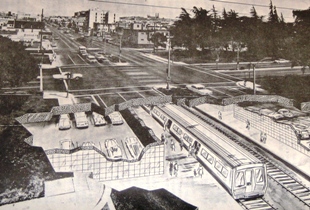
Artist's conception of a proposed BART station below Geary and Park Presidio Blvds
The idea was that a streetcar line above ground provided redundant service to the rapid, heavy rail line below. In later years the entire Geary corridor was further redesigned to move motor traffic more quickly. The end result in 2008 2009 is that one of San Francisco's most dense neighborhoods, the Richmond District, is drastically under served by transit; most riders funnel onto the 38, which is the busiest single line in Muni's system. The entire Geary corridor is the second most heavily-traveled, with 56,473 daily boardings along its four bus lines.
There are plans in the works (though currently years away from implimentation) to remake Geary with a bus rapid transit (BRT) line down the middle. One of the alternatives discussed in the official plans is to build a BRT right of way that could be retrofitted in a few years to run light rail (a reborn B-line?) from downtown to Ocean Beach. But why wait? Are we suggesting that Geary, with 30,000 more daily riders that pre-T Third St or 5,000 more daily riders than the N-Judah (Muni's busiest extant rail line), is less deserving of full-blown light rail than those lines?
Geary needs light rail now! More than that, it needs comprehensive transit options, with convenient local service and rapid cross-town access. Geary needs what Market St. has right now: A streetcar on the surface (preferably in its own ROW) to move neighbors to shops and provide convenient access to local amenities, and a subway line below to get commuters across town quickly.
Arguments that demand for transit need to be proven before a system so robust is built are flawed to begin with, but in the case of Geary, the demand for ridership is already proven. Induced demand has been proven in road projects, and a similar results can happen along "overbuilt" transit lines. To give San Francisco a web of transit arteries would be to build a system that is capable of accomodating growth for the future.
Subscribe to:
Posts (Atom)


 Posts


