Monday, January 19, 2009

Sidewalks Are For Everyone

News from Streetsblog SF about the LightHouse for the Blind and Visually Impaired's current campaign against sidewalk parking, Sidewalks are for Everyone (SAFE).

The aim of SAFE is to discourage sidewalk parking not punishing them through enforcement measures, but by gently but pointedly reminding drivers of the consequences of their actions. I hope it works, and I commend them for making the effort.

As I type this, however, my freaking jaw is on the floor:
SFPD Sergeant Steve Quon of the Taraval Station said he's not inclined to enforce sidewalk parking, except in instances where there are significant complaints. "There are so many cars on the sidewalk on 19th Avenue, if we cited one, we'd have to cite all of them. That's a lot of citations. There's not a lot of pedestrian traffic on 19th. As you can see, there's nobody on it right now."

When it was suggested he's missing out on a lot of fine revenue, he replied: "We don't look at it that way. We can't look at it from a money factor, because it doesn't really go into our pockets. We don't get a percentage or anything." (Streetsblog SF)

My first thought is that nobody walks on 19th Avenue because there's no enforcement of parking and traffic violations. I'd have to be insane to walk on a sidewalk dotted with parked cars, along a street with one of the highest pedestrian injury and death rates in the city! Any talk of improving the situation along 19th Ave is useless if we won't even make the most bare minimum effort to enforce violations.

And the inference that PCOs have no interest in enforcing the law because they don't get a cut of the fines... what?! I'm speechless.
SFMTA spokesman Judson True assured Streetsblog San Francisco managers at the Department of Parking and Traffic (DPT) have told their employees to enforce any instance of sidewalk parking they encounter. (Streetsblog SF)
This runs counter to both Sgt Quon's statement above and to my own experience. More that once I have called the DPT hotline and reported a sidewalk parker, only to have nobody show up to cite the offender. I can go onto everyblock.com to see the resolution of my report, and read with my own eyes that no action was taken. If you like, you can stand on the sidewalk in front of your house on street sweeping day and watch the PCOs ticket cars parked on the street and ignore those on the sidewalk. They are clearlty not enforcing "any instance of sidewalk parking they encounter." Not even the low-hanging ones.

Friday, January 16, 2009

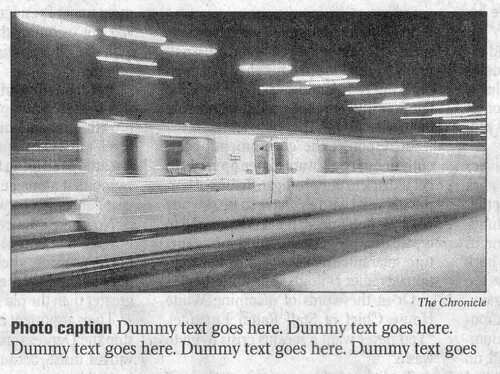
Rare Moment of Clarity in Comical Photo Caption

This made me laugh out loud. From The Chronicle's article on the MTC dedicating funding to the BART Warm Spring extension:

I love it. All the more appropriate that it appeared one page after the ridiculous editorial against congestion pricing.

Let me pause to say I have been a full-price, 7-day a week home subscriber of the Chron for over four years, and I've been reading it every day since I was in high school. The quality of the paper has been dwindling for years, most drastically since it was bought by Hearst Corp. Pick up today's paper and choose an article at random. Chances are you won't find much difference between that article and 15 inches of "Dummy text goes here. Dummy text goes here."

An exception to the near universal mediocrity is the reporter who tends to cover Muni and other transportation stories, Rachel Gordon. Her stories are well-written and tend to provide more insight than is otherwise available in local media.

Thursday, January 15, 2009

The Chronicle's Half-Baked Editorial Opinion

The Chronicle Comical's editorial against congestion pricing is the latest nonsensical opinion to dribble across that once-halfway-decent page. The irrational diatribe claims that the market-driven plan to charge cars to drive downtown (during rush hour only!) is a "half-baked" "eco-friendly idea" that "may be too much even for San Francisco."

One of San Francisco's "relatively unclogged city streets," according to Chronicle editors who apparently don't get out much


$30-60 million may be a relatively small amount of money to a business like The Chronicle that loses that much each year, but it is in fact a significant amount of money for the regions transit agencies. That's a full tenth of the SFMTA budget! But if it suits the accounting sensibilities of the Chron, I'd be perfectly happy setting the price by supply and demand, the way our parking meters soon will.

The clueless editorial writer guffaws, "The city's official slogan might as well be: Don't Drive Here," but "Don't drive" is indeed city policy. Section 8A.115 of our City Charter, our "Transit First" policy, specifically states that
Decisions regarding the use of limited public street and sidewalk space shall encourage the use of public rights of way by pedestrians, bicyclists, and public transit, and shall strive to reduce traffic and improve public health and safety.
As I've said before, congestion pricing is not punitive! The fact of the matter is that motor vehicle drivers have been receiving a public subsidy for years. Congestion pricing plans are just a step toward presenting people with the true economic costs of their decisions. That most people would consider the costs of driving too much to make it worthwhile most of the time is not a reason to hide that cost from them, especially when the agreed-upon goal on both sides is to get them to stop driving.

Tuesday, January 13, 2009

Mud Flow on 16th Street


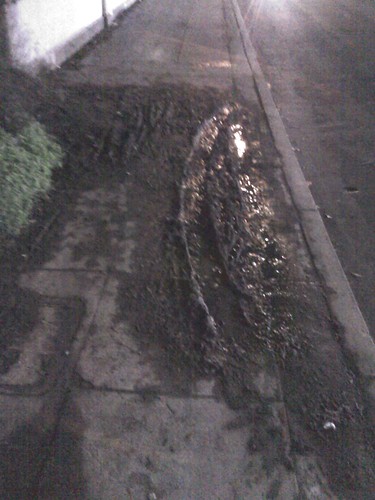
Excuse the crappy cell phone pic. This mud flow on 16th St. below Franklin Square Park has left the sidewalk barely passable for even able-bodied people for months now.


This slick, smelly mud pile has been blocking the South sidewalk of 16th St (across from the Potrero Center Safeway) for months now. I just reported it to the city using the new online version of the popular 311 service. The section of hill here, on the edge of Franklin Square Park, is un-retained, and the mud has been spreading for years. Note the tire track right through the middle of it. I would hate to have been walking down the sidewalk when whoever did that skidded across.

While trying to find an address to use to alert the city to its approximate location, I made an interesting discovery. This section of sidewalk is an intersection!

This screenshot of the SF City Assessor's map shows Hampshire St continuing to 16th

Here's a Google map of the area for comparison:


View Larger Map

How would it improve this unnecessarily blighted block to open Hampshire up to through traffic, even perhaps with a set of public stairs (leaving it a dead-end to cars)? Any public space here would have to be well-planned, because Franklin square is notorious for homeless encampments. But a streetscape that encourages the flow of pedestrian traffic (instead of mud) could bring life back to a block that's been neglected for too long.

Monday, January 12, 2009

You will be the butt of jokes if you fail to think big

Americans pride ourselves on thinking big and following through on those dreams. Nobody would argue that it's anything but a point of pride to have the tallest building, the longest bridge span, etc.

That mindset is present even when planning the less sexy segments of our public infrastructure. Unfortunately that's mostly only true for asphalt projects. From Jon, commenting on The Overhead Wire:

the urban ring should really be subway, too bad boston spent all their money on the big dig back when subways were still being built.

this is what gets me, a transit oriented city like boston (nyc, chicago, philly too) has for the most part the same subway system that it had 50-80 years ago. for any new expansion they have to settle for buses when grade separated rail is whats needed. they need to be ambitious now and plan some subway and fight for the federal transit money to pay for it.

Replace Boston 50-80 years ago with SF 40 years ago and you have the situation as I see it.

To the extent that there is any big-thinking going on here, it's poo-poohed by the inbred pool of political power. The most we seem to get are proposals to push BART to the edges of the state or the world's slowest BRT. Our much-championed Transit Effectiveness Project (TEP) is a "consolidation of service" (Muni's euphemism, not mine) not a plan for a truly effective transportation network. Heaven forbid we move the region or even the densest city outside of Manhattan away from a 1:1 parking ratio.

What if this is stimulus is our chance to make game-changing capital improvements, along the lines of the Market Street tunnel, and we blow it? We'll look like fools, and more than likely do it anyway decades late and for billions more.

Thursday, January 8, 2009

The Silver Bullet or the Werewolf?

The line in support of congestion pricing starts here.

Think of Soviet shoppers spending their lives in endless queues to purchase artificially low-priced but exceedingly scarce goods. Then think of Americans who can fulfill nearly any consumerist fantasy quickly but at a monetary cost. Free but congested roads have left us shivering on the streets of Moscow.

I can't think of a single reason not to apply congestion pricing to San Francisco.

It all starts with walkable streets

Eric at the must-read Transbay Blog has an excellent post about the connection between the pedestrian environment and the overall health of our cities. Specifically he's rallying support for the Congress for the New Urbanism's recent proposal to include dense, livable streetscape improvements in the upcoming Federal stimulus bill:

The CNU proposal leverages the power inherent in a street grid to disperse traffic throughout an open, integrated network of routes. This is preferable to funneling a high volume of cars onto a few wide arteries, which encourages many drivers to use the exact same route. As a result, these wide arteries attract congestion like a magnet, and when the roadway reaches capacity, there is the perception that it must be widened to further increase capacity, leading to a vicious cycle of induced demand. ... This pattern has led to the decline of many once-prosperous urban districts and corridors, including here in the Bay Area. It confirms our observation that the freeway/artery model is inferior to the grid model, in which traffic is dispersed throughout a network of streets.

Investing in the rennaisance of our neglected urban cores - and in the creation of new urban areas where previously cars were king - will yield more bang for our buck than any freeway widening project, and should be a part of any taxpayer-funded stimulus package.

Please let your elected representative know how you feel about this.

Wednesday, January 7, 2009

BART would be foolish to cut service

The news today is that BART is maybe thinking about planning to reduce service at night and on Sundays. Bad bad bad bad bad idea. according to the Comical Chronicle, the idea is to save a million bucks in response to the $8 million hole Schwarzenegger has put them in.

Come on, a lousy million? some quick math suggests they might want to look at potential savings other than cutting the already minimal service levels. The average BART fare is around $2.75, so $1 million is roughly 363,636 trips. That means if the service discourages people from making that many trips (or 181,818 round trips) the savings will be a wash. If you think that's unlikely, since 181,000 is a lot of people, remember that's around 3% of the 100million plus trips per year that BART handles. Coupled with rock-bottom gas prices and increases in the cost to park at a suburban BART lot, it's not unthinkable to lose that many choice riders over the course of the year.

In addition, it's an unnecessary burden on those of us who depend on BART and other public transit to move around the region.

To be clear, the BART directors are only the proximate villains here. The ultimate responsibility is on Schwarzenegger and Sacramento Republicans who have been strangling the flow of money to transit for years. BART has been asked to do more with less for some time now. But reducing service and raising fares (doing less for more, from the standpoint of riders) is not a real solution. It creates a positive feedback look of lower ridership, lower revenue, and more cuts down the road.

While looking up some info about BART ridership, I found this interesting analysis from last year. I don't think this guy has the complete answer, and I'm opposed to any change to the fare structure that benefits long-ride suburban and exurban commuters over the urban core of the system (which actually generates revenue). One gem to consider is that the BART director discussed in the post, Joel Keller, represents a district with only one station in it.

It's clear that the BART board ought to be restructured in some way to allow for proportional representation of the district constituents. Tom Radulovich, Carole Ward Allen and Lynette Sweet, who represent the core of the BART system with the majority of riders, hold a tiny minority on the 9-member board. So it comes at no surprise that the vast majority of capital investment goes to cost-negative expansions of the system to the far reaches of the region. BART to San Jose will cost $6 billion with a B, and maybe result in 100,000 new riders in 2030 (although this prediction is highly suspect). How many riders would join the system if that money was spent on an infill station at 30th and Mission or on an extension down Geary?

BART's constant budget pain is hurting the system in the long run, and it's being made worse by wrongheaded decisions to cut service and expand the system to lower-density regions.

And if you wonder why a blog about "pedestrianism" spends so much time bellyaching about transit, read this great piece by the Santa Rosa CityBus. The North Bay seems like an unlikely source for such transportation wisdom, but they really hit the nail on the head.

Monday, January 5, 2009

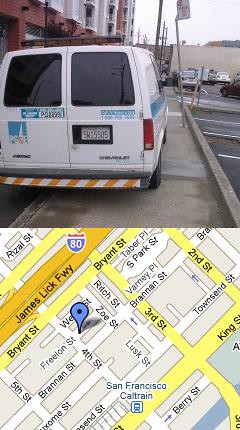
Sidewalk Parking - 4th and Freelon


PG&E truck blocking the sidewalk on 4th St. and Freelon in SoMa

To report sidewalk parking in SF, call DPT at (415) 553-1200
Hit 1 for English
4 for "more options"
3 for "sidewalk parking"

Friday, January 2, 2009

Congestion hooey?

Editor - As a former San Franciscan who now lives in the North Bay, my response to the proposed "congestion pricing" schemes is: "Are you kidding?"

For a city that fiscally depends on outsiders - tourists, commuters, shoppers and diners - congestion pricing is a really stupid idea. There is no good public transportation to get to San Francisco from the North Bay unless you are commuting to the downtown business district. Outside commute hours, the ferries and buses run infrequently, and after a late dinner, there is no way to get back to Marin. Even finding a taxi is practically impossible.

In addition, those proposing this idea might look at a map. Most of the time I'm driving through the "ring" I'm not driving to San Francisco, I'm driving through it to get to the airport or somewhere else on the Peninsula. Want to relieve congestion? Build a freeway from the Golden Gate Bridge to the intersection of 101 and 280 just south of Parkmerced, and you won't have to worry about us again.

SARAH CAMERON LERER

Inverness

Letters to the Editor, SF Chronicle, January 1, 2009

No, Ms. Lerer, we're not kidding. San Francisco, specifically the older, denser northeaster corner of the city, has been suffering under the burden of motor vehicle congestion for decades!

It's difficult to know where to begin tearing this letter apart, but her specific arguments don't even weigh against the specific plan for downtown San Francisco. She is worried that the only public transit options from the North Bay take you to the downtown, and are only reliable during commute hours. Fortunately, this is the only part of town, and the only time of day that will be affected by the congestion fee.

She also laments that the fee is unfair because she's only passing through the congestion zone, not visiting it. She even suggests that we build a freeway through our city to get her to I-280. This is exactly the kind of trip that worsens congestion without providing any benefits to the local economy, and it's exactly what congestion pricing is designed to prevent or move to off-peak hours.

If you want to push one of my hot buttons, try suggesting that the elevated freeways that scar our city are a good thing, or that we need more of them. Building a freeway the entire length of San Francisco won't mean we never have to worry about those cars or the people in them ever again, it will mean blight, crime, higher rates of asthma, heart disease and a slew of the other unarguable effects of high vehicle traffic volumes. What's more, California Highway 1 already runs the entire route she wants, via Park Presidio Blvd and 19th Ave. The status quo along that gem of a roadway is unacceptable exactly because it's overused by Ms. Lerer and her ilk.

The city of San Francisco doesn't owe suburban residents a free ride through our neighborhoods. Congestion pricing is not punitive, it offsets real costs that the city has been shouldering all these years. The plan is sound and serves to allow drivers, cyclists, and those who walk and take the bus to make more well-informed economic decisions about their transportation options.